Why the time your money spends inside the business matters as much as the margin it earns
The Question I Hear Most
"We are making profits. Then why is there no money in the bank?"
I have heard this question from founders, from boards and, at times, I have asked it myself. Over about ten years in finance, across during practice, education technology, construction, passenger mobility and consumer electronics, I have come to believe it is the most common and the most misunderstood problem in growing businesses.
The usual answer is a lecture on accrual accounting. Revenue is booked when you sell, cash comes when the customer pays, and the gap sits on the balance sheet. All true. But that explanation rarely helps anyone fix anything.
What has helped me far more is a simple habit: follow the money through the business, from the day it leaves to the day it comes back, and ask at every step why it is waiting.
Your Money Is on a Journey
In any business that buys, builds or holds something before selling it, cash goes on a journey. It leaves when you pay a supplier. It sits as raw material or stock. It moves through operations while the product is made ready. It waits while the product is sold. And then it waits again while the customer takes their time to pay.
Throughout this journey, the profit and loss statement can look perfectly healthy. The margin is real. The sale is real. The profit is real. It is simply not in the bank yet.
Most management reports show the destination, the profit. Very few show the journey. So the first exercise I recommend to any leadership team is to map it, stage by stage, and to ask a few uncomfortable questions at each point.
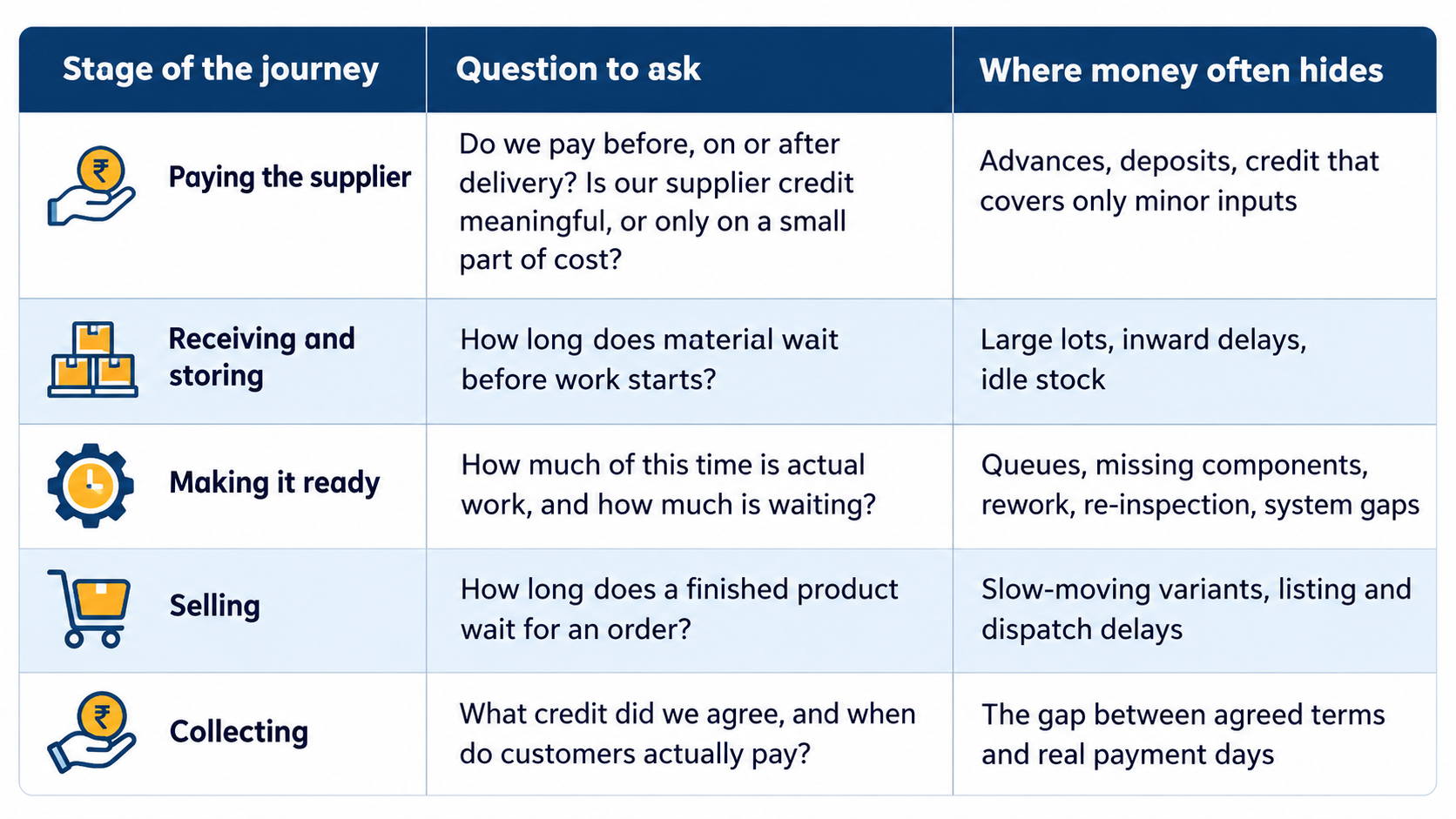
A simple template. Fill in your own days for each stage.
When teams do this honestly, two things usually come out. The total number of days is much longer than anyone assumed. And the stage everyone focuses on is rarely the one holding the money the longest.
Selling Is Often Not Where the Time Goes
When cash gets tight, the first instinct in most businesses is to push sales harder.
But in operations-heavy businesses, whether manufacturing, construction, repair, assembly or anything with multiple processing steps, I have repeatedly seen that the longest wait sits inside operations, not in the market. The product is almost ready, but it is waiting. For a component. For a technician. For a quality check. For a system entry. For approval.
The obvious reaction is to conclude that operations must be slow. That is only partly true, and this is where I think many finance leaders get it wrong.
Some delay is simply the nature of the business. If your inputs vary, if customers want customised products, if every unit needs inspection and some will fail it, then a certain amount of rework and waiting is built into how you create value. You cannot remove it. You can only plan for it, finance it and price it in.
The rest is controllable. That is where cash can actually be released.
So before asking operations to "reduce days", separate the two. Days that belong to the nature of the business are a financing and pricing question. Days that belong to queues, handoffs, batching and habits are an execution question. Mixing them up means fighting the wrong battle,.
Rules Are Easy. Consistency Is Hard.
On the controllable days, most businesses do the sensible things. They set service levels for each stage. They define what should be checked, by whom and when. They try to identify everything a job will need at the very first inspection, rather than discovering one requirement at one stage and another at the next, so that the waiting happens together rather than one after another. They limit unnecessary handling, because every extra touch adds a queue and a chance of a new problem.
These steps work. But the most important lesson I have learnt is what happens after they are introduced.
The problem stops being the absence of rules. It becomes the consistency with which they are followed.
A process that works well when people follow it will not deliver results if it is followed on some days and skipped on others. A service level that says two days is meaningless if the reality is regularly double. And the gap between the rule on paper and the practice on the floor is exactly where the money sits.
Some of that gap comes from systems. A job is complete, but a system limitation means it cannot move to the next stage, and a finished product waits for a process step.
Some of it comes from checks that do not catch everything. A component passes an early test and fails a later one, so the work goes back, gets checked again, and each round creates the possibility of a new problem.
And some of it comes from what we measure. When people are measured on activity, a few will find ways to create activity. Work gets repeated, touched again or spread over more days than needed, so that the numbers point in the right direction. Every repeated touch creates rework. Rework creates re-inspection. And the cash waits a little longer each time.
For a finance person, this is the uncomfortable part. A measure introduced to improve efficiency can quietly produce delay. That is not only an operations problem. It is a governance question. What we measure and reward decides how long our money stays inside the business.
The Customer Side: When 30 Becomes 45
Once a product is sold, the second half of the wait begins.
In B2B business in India, one pattern is remarkably consistent. A customer asks for 30 days of credit and pays in about 45. A customer who asks for 45 days pays in about 60. The delay is rarely a surprise. It is a habit, and habits can be planned for. The Average credit cycle in Indian Economy pretext lies from 60-90 days.
Many businesses take credit insurance, and it is worth having. But I have learnt to be clear about what it does. Credit insurance protects you if a customer does not pay. It does very little when a customer pays late. Salaries, supplier payments and GST do not wait for an overdue invoice, and no policy funds those extra fifteen days.
Invoice discounting can bridge that gap, and used well it is a sensible tool. But it is not free. Every day of discounting is a cost that quietly comes out of the margin the business worked hard to earn. Offering a better rate for advance or early payment is another option. For some customers, a slightly lower price paid upfront is a better deal for both sides than a higher price collected two months late.
Seen this way, credit terms are not just a sales concession. They are part of the price.
The Cost of Growth Nobody Calculates
There is one calculation I find founders struggle with more than any other: the cost of growth. Not the cost of new hires or marketing. The cash that growth quietly absorbs.
Every additional rupee of sales needs more stock, more work in progress and more money waiting with customers. Take a simple illustration. Suppose a business needs about 30 paise of working capital for every rupee of annual sales, and earns about 8 paise of profit on that rupee. Every rupee of growth then locks up nearly four times the cash it generates. A business like that can fund perhaps a quarter to a third of growth from its own profits. Anything faster has to come from a bank, an investor or better terms.
Most growth targets are set on market opportunity. Very few are set after asking a basic question: if we grow by this much, how much extra money gets locked inside the business, and where will it come from? When that question is not asked in the planning meeting, the bank balance usually asks it six months later. Answering it early is what turns a cash crisis into a funding plan.
What I Would Tell a Growing Business
If I had to put this into a few practical lessons, they would be these.
-
Map the journey of your cash. Count the days from the moment money leaves to the moment it returns, stage by stage. The number will surprise you, and it will tell you more than any single ratio on the balance sheet.
-
Separate structural days from controllable days. Some delay belongs to the nature of your business. Finance it and price it. Put your energy into the rest.
-
Calculate the cost of growth before you set the target. Know how much working capital each rupee of new sales will need, and plan the funding in the same meeting.
-
Look beyond sales for cash. In many businesses, the longest wait is inside operations, not in the market.
-
Do not stop at setting service levels. Check whether they are followed consistently. The gap between the rule and the reality is where the money is.
-
Review what you reward. If a productivity metric encourages repeated work, it will cost you cash while looking like efficiency.
-
Know what your credit insurance covers, and what it does not. Default and delay are two different risks.
-
Treat credit terms, discounting and early-payment pricing as financial decisions, not only sales decisions.
Profitability Follows Working Capital Management
For a long time, I thought of working capital as something that supported profitability. Manage it well, and the business runs smoothly while profit does the real work.
I now see it the other way round. Profitability follows working capital management.
When cash moves slowly, the business pays for it everywhere. It pays in discounting charges, in rework, in capacity tied up in unfinished work, and in growth that has to wait for funding. The margin on paper stays the same, but the business keeps less of it.
When cash moves faster, the same margin is earned more often, on the same money, with less borrowing.
As finance professionals, we are trained to protect the margin. Experience has taught me to protect the time as well. The days money spends waiting, for a component, a check, an approval or a payment, do not appear anywhere in the profit figure. But they decide how much of that profit the business actually gets to keep. Watch the margin, by all means. Watch the days even more closely.
About the Author
Ashish Nirmal is a Chartered Accountant and the Chief Financial Officer of an NSE SME-listed refurbished electronics company based in Bengaluru. Over about a decade across a CA practice, education technology, construction, intercity passenger mobility and consumer electronics, he has worked on public listing, fundraising, investor relations and working capital management. His work focuses on governance, financial discipline and the practical use of AI in finance.