Artificial Intelligence has taken a firm foothold in talent acquisition with considerable capability. AI-powered applicant tracking systems can parse thousands of resumes in minutes. Job fit can be modelled with predictive analysis with impressive accuracy. Automated screening, a process vulnerable to subjectivity, is improving quite considerably.
What does the data tells us: AI is currently used in the hiring process by 67% of organizations, a percentage that has almost tripled since 2022. However, the same study reveals that even after implementing AI, 67% of those organizations continue to struggle with bias management. The procedure has been automated. The problem has not been fixed.
Strengths and Limitations of AI in Talent Acquisition
AI-powered resume screening can reduce time-to-shortlist quite significantly. Predictive models are trained on performance data and can filter candidates with a higher probability of strong job fit. Automating routine communications and scheduling removes friction from a process that has always been a burden on administrative overhead.
With well-defined structured roles, clear success criteria and historical data is available, AI-driven screening achieves accuracy rates of 89 to 94%.
AI is very good at finding candidates who match a pattern. If you can identify the right pattern, if you have past data reflecting the kind of candidate who succeeds, the tool will perform well.
The difficulty arises where the pattern runs out. AI learns from the past, it will inherit any blind spots from your hiring process.
AI Struggles With Non-Linear Careers and Non-Linear Careers Are the Future
Linear progressions, standard job titles, predictable industry moves was the foundation of historical data that artificial intelligence was built on. It learned what a successful candidate looked like by studying the ones who came before. This logic works reasonably well when career paths are stable and predictable.
A transformation programme manager with diverse experience in banking, consulting, and digital operations. A senior specialist, who moved between industries precisely because they were solving harder problems. These profiles do not fit the pattern. They are filtered out before a human ever sees them. Cross industry transition gig to full time employees, and skills built entirely outside the traditional employment structures are no longer exceptions.
This matters most in the hiring categories where enterprises can least afford to get it wrong — emerging technology roles, leadership appointments, and large-scale transformation programmes. These roles demand adaptability, cross-functional thinking, and the kind of resilience which is acquired only after working in unconventional trajectories.
The correction is not to abandon the AI screening process but limit it. Use it for initial filtering on primary criteria, then introduce a human intervention for assessing the career trajectory. This will help in identifying the qualities that goes beyond their resume like:
Why did this candidate pivot?
What does the pivot/multiple industry experience tell you about how the candidate can think and grow.
The Right Division of Labor
The question is not whether to use AI in your talent acquisition process. The answer to that is yes, and the efficiency case is strong. The question is where to use it, and where to protect the areas for human judgment. In my experience, the most effective enterprise hiring programmes are the ones that deliver strong placements, low attrition, and durable client relationships.
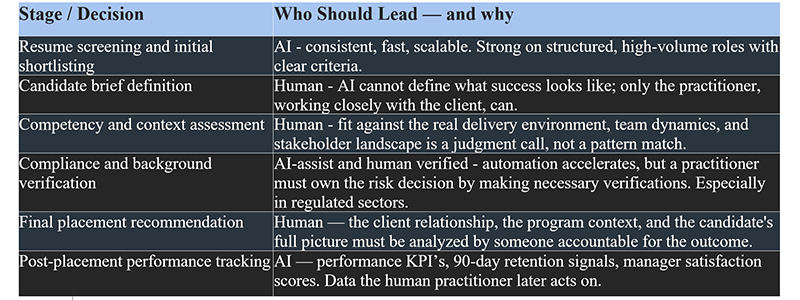
This framework helps AI practice its strengths – the parts of the process where speed, scale, and consistency are the primary value. And the practitioners practice their strengths - the parts where context, judgment, and accountability determine whether the placement actually works.
The primary problem in enterprise placement is rarely skills mismatch. It is the context gap. The ability to judge the difference between job description and the candidate’s potential. Identifying the right technical competencies can be transferred meaningfully across sectors and which do not. What a candidate’s career trajectory signals about his adaptability to dynamic situations
Intelligence x Intuition
Neither machines nor human instinct alone can make accurate decisions. AI has revolutionized talent acquisition with its speed, scale and consistency across high volume programmes. However, capability is not the same as completeness.
Workforce investments compound over time when the algorithm did what it does best, and the practitioner stepped in precisely where the algorithm runs out.
The key is to identify whether the right judgment is being applied at the right moments and whether the people responsible for those moments have the context, the accountability, and the experience to make them count.
About The Author
With over 16 years of experience in recruiting, selling and managing multiple large MSP enterprise clients for IT and Professional services, Vishal S. Chaudhary stands as a pivotal figure at Dexian. As the Director of Staffing and Placements, he is responsible for strategic new-client acquisition, managing overall MSP Alliances, centralized MSP client operations, and supporting the expansion of Regional and Fortune 500 BFSI clients.
Under Vishal’s leadership, Dexian Inda has experienced remarkable growth achieving a 100% increase in resource headcount and a 250% surge in gross profitability across various client engagements. His expertise is backed by a Bachelor of Engineering degree in Information Technology and extensive experience with renowned multinational corporations such as Randstad, Allegis Group – TEKsystems, and Collabera Technologies.
Vishal’s contributions and strategic vision continue to drive Dexian’s success, solidifying its position as a leader in the industry