The Myth of Work-Life Balance
Ask a woman juggling work, home, relationships about work-life balance, and you might get a sigh, a thoughtful - “I hope I get there at some point”, or a frustrated “what a joke.” What you will not hear is an affirmative, that her life is well(ness) balanced. In Indira Nooyi’s words, “Anybody who uses the word balance is crazy.” And yet, as women, we crave this balance - a state where there is undisturbed time for work, home, and self.
The main driver for this craving is the time-poverty we face. As per 2024 India Time Use Survey, women spent 20% of their time on unpaid care work on a daily basis, as opposed to 2.6% by men. Now add in the mental load of planning, running the household, and work-related time spent. Where does “self” feature in the work-life balance?
Women in India
As someone who had the privilege to pursue her educational dreams, I looked forward to a meaningful career, but family commitments stood in the way, and a career break became inevitable. This is the story of millions of women in our country, where education doesn’t always guarantee professional continuous success. Imagine then, the plight of women who dream of being financially independent, yet, without the means for foundational education.
According to the 2024 OECD global time use database, Indian women spend most of their time on domestic, unpaid work, only second to Kazakhstan. Generations of conditioning and the need to fit into the societal mould of the devoted wife, caring mother and daughter has brought us this rather heavy ‘accolade’.
The Silver Lining
Despite being placed second last, we do have a silver lining. India ranks third globally for women holding senior management positions, and ahead of the global average for women-led businesses. So, we are in a contradictory position: we rise rapidly into leadership roles, but simultaneously, we struggle with a much heavier burden of domestic and professional labour than our global counterparts.
Is this Resilience?
For more than a decade, I worked in the private education industry, where over 90% of the workforce was women. In my journey, I have seen truly remarkable individuals - those managing the needs of a special-needs child at home while pursuing a career, single mothers making ends meet, women dedicating their time to teaching in remote villages and visionary leaders.
Amidst these many stories and diverse backgrounds, our conversations always shared a common thread: how do we manage time in the best possible way to beat overwhelm? How do we act as the perfect role models to our girls and society, without burning out and giving up? How do we do it all, without losing our sanity?
Is this what resilience looks like? Yes, definitely. It takes immense sacrifice to be the anchor at home while refusing to give up on our dreams. But this sacrifice comes at a great cost to our physical and mental well-being.
Not Balance, But Harmony
These conversations, along with discussions with women across other sectors, made me realize that we are constantly seeking solutions to manage our time and well-being better. For the last three years, I have spent my time building a mindful productivity app aimed at helping individuals plan their days with intention. This experience leads me to believe that work-life harmony is a much more achievable goal than balance.
What is the difference? Work-life balance hinges on a 50-50 division of our time, where one large block is strictly dedicated to either work or life. But very rarely can we align our thoughts strictly to eight hours of work while ignoring life entirely, especially if we are the primary caregivers at home. Furthermore, work seldom stays at the office; we manage team meetings, calls, and obligations well beyond official hours.
Work-life harmony, on the other hand, is about accepting that we have multiple competing responsibilities and learning to integrate both work and life in a way that makes us effective, without compromising our well-being. The keyword here is harmony.
What makes a harmonious life?
Let’s try an exercise. Plan an ideal day for yourself. Now ask yourself:
-
Why do you feel this is the ideal day?
-
Does this day depend on other things or people?
-
Does it have elements that actively address your well-being?
-
Would this plan be fulfilling enough that you would want to live it every day?
Through this exercise, a few things become clear: what your priorities are, what (and who) energizes you, and what you actually want as a sustainable practice versus a once-in-a-while treat.
This reflection helps us reconcile with the fact that life comes with both responsibilities and personal goals. A purpose-driven life, where we intentionally target our goals without compromising on self-care, is what most of us wish for. And yet, on most days when there is a time crunch, the first thing out of the window is our 30 minute fitness session or the peaceful lunch time that we had hoped for.
Practical Strategies for Work-Life Harmony
Does achieving work-life harmony hinge on fully remote work? Nothing beats the flexibility offered through remote work, provided we stay on task without getting distracted. However, there are small changes we can bring into our lives even if we are expected to be physically at an office for eight hours a day.
Time-block your day
Time blocking is a popular time management technique. Your calendar schedules might look like time-blocking. However, on a daily basis, to plan every 30 minutes of your day can be exhausting. To make this a sustainable habit, categorize your blocks: Work, Home, Self, Other. By blocking specific times for broader categories, we train our brains to process information aligned with that current focus.
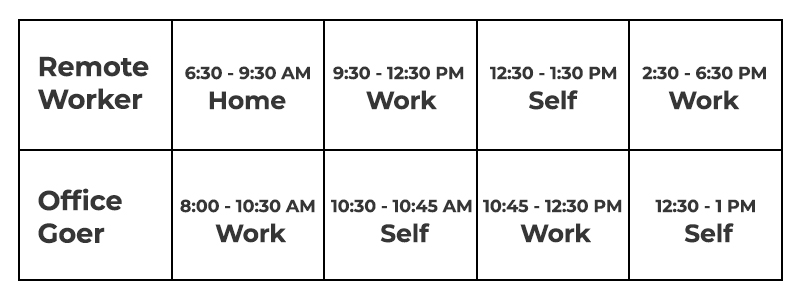
Table 1: Example of Modified Time Blocking using categories
Prioritize ruthlessly
If you’re used to starting your day with a task dump and then deciding which ones you feel like doing, it might get overwhelming early on. Instead, spend a few minutes deciding which are the non-negotiable, high priority tasks for the day. Pick only 3 to begin with. Complete these tasks before planning others. How does one prioritize though? The Eisenhower Matrix is a great way to think about tasks: i) Very important and very urgent, ii) important but not urgent, iii) urgent but not important and, last and definitely of least priority is iv) neither urgent nor important.
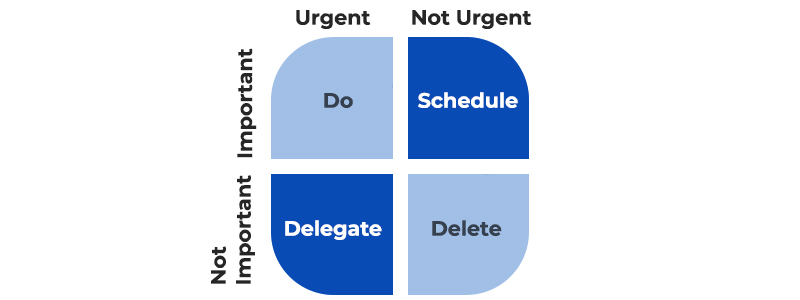
Image 1:The Eisenhower Matrix
Delegate without fear
One of the biggest traps we fall prey to is believing that we know best, and therefore must do it ourselves. This applies to everything from folding laundry to creating a presentation. If a task falls into the "urgent but not important" quadrant of the matrix, delegate it. Build a support system you can rely on.
Take Mindful Breaks
Staying up until midnight because you had a long work day followed by taxing home related tasks isn’t a break. Replace screen addiction with fitness routines, meditation or a simple stroll in the park.
Pause to smell the roses, take the time to savour what you eat and spend time with people who matter.
Track your progress
Tracking doesn’t require meticulously color-coded spreadsheets or expensive project management tools. Striking items off a simple To-Do list offers the same psychological satisfaction. Track not just your tasks, but your daily self-care time blocks. To build accountability, share your well-being plans with family and friends. As you build awareness of your time-savers, time-wasters, and intrinsic motivators, you will get better at creating a harmonious life. In the words of Confucius, “It does not matter how slowly you go as long as you do not stop.”
The Way Forward
While I have focused on what we can do at an individual level to cultivate work-life harmony, true progress requires systemic change at the community, corporate, and national levels. For women to truly thrive, we need a widespread evolution in how society and workplaces operate:
-
Equitable Corporate Policies: Human Resources policies are slowly evolving, but we need extensive adoption of systems that offer robust maternity leaves, flexible return-to-work programs for women re-entering the workforce after a career break, and asynchronous hybrid work models.
-
Accessible Mental Health Infrastructure: Organizations must provide access to on-site healthcare, wellness days, and professional counseling to help women actively manage their mental well-being and combat burnout.
Resilience shouldn't mean enduring a broken system. By advocating for systemic support while practicing mindful, intentional productivity in our own lives, we can move away from the myth of balance and finally step into a sustainable, fulfilling harmony.
About the Author
After more than a decade shaping minds as an educator, curriculum developer, and manager in the education sector, Ahlada Janani Sudersan transitioned into entrepreneurship with a focus on well-being. She is the co-founder of ZEN-it, India’s first mindful productivity app, where she builds tools designed to help individuals pursue their goals, achieve high productivity, and cultivate work-life harmony without the burnout.